
Small Business Guide To Lenovo Vs Dell Servers
by Maya Hatt | Jan 6, 2026 | Uncategorized |

Choosing the right server for your small business is a big decision. Two top brands often come up: Lenovo and Dell. Both offer reliable servers built for small and mid-sized companies. This guide breaks down Lenovo vs Dell servers to help you pick the best fit. You’ll learn about performance, support, cost, and reliability in simple terms.
Table of Contents
-
Why Choose Between Lenovo and Dell?
-
Lenovo vs Dell Tower Server Comparison
-
Performance and Hardware
-
Support and Warranty
-
Reliability and Uptime
-
Pricing and Value
-
Which Server Is Right for Your Business?
-
Frequently Asked Questions
Why Choose Between Lenovo and Dell?
Dell and Lenovo lead the business server market. Dell’s PowerEdge line has served small businesses for decades. Lenovo bought IBM’s server division in 2014, bringing enterprise-grade engineering to their ThinkSystem servers.
Both brands make tower and rack servers for common business needs. Dell excels at high-performance setups and custom options. Lenovo offers strong value with IBM’s proven reliability built in.
Common small business server uses:
-
File storage and sharing
-
Data backup and recovery
-
Running business apps and databases
-
Email hosting
-
Virtualization of multiple services
Dell and Lenovo both handle these tasks well. The difference is in how they deliver results.
Lenovo vs Dell Tower Server Comparison
 When comparing Lenovo vs Dell tower server options, hardware specs look quite similar. Both use Intel Xeon or AMD EPYC processors, ECC memory, and enterprise drives. A server with the same CPU and RAM performs alike regardless of brand.
Key hardware differences:
Dell strengths:
-
Wide range of custom options
-
Top-tier performance configs available
-
PowerEdge T-series for entry to advanced needs
-
Extensive expansion choices
Lenovo strengths:
-
Budget-friendly pricing
-
Power-efficient designs
-
Quiet operation (26 decibels on some models per TechRadar)
-
Generous expansion bays even in basic models
Dell offers more bleeding-edge options for demanding workloads. Lenovo focuses on solid performance per dollar. Both brands scale from basic file servers to powerful virtualization platforms.
Performance and Hardware
Lenovo vs Dell business servers deliver comparable performance for similar specs. Your choice depends on specific needs.
Dell PowerEdge advantages:
-
High customization for specialized workloads
-
Multiple processor and GPU options
-
Advanced RAID controllers
-
Strong for heavy virtualization
Lenovo ThinkSystem advantages:
-
Lower power consumption
-
Cost-efficient performance
-
Reliable for 24/7 operation
-
Good for standard office workloads
According to Szwecent Tech, Lenovo emphasizes cost-efficiency and reliable uptime. Dell excels in high-performance workloads and custom setups.
Both brands support common virtualization tools like Hyper-V and VMware. Entry-level towers from both can run file sharing, backups, and office apps smoothly per Kraft Business.
Support and Warranty
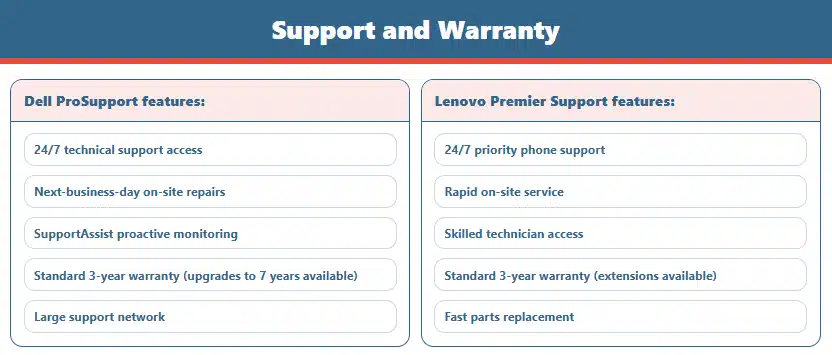
Support matters greatly for small businesses without IT teams. Both companies offer strong business support packages.
Dell ProSupport features:
-
24/7 technical support access
-
Next-business-day on-site repairs
-
SupportAssist proactive monitoring
-
Standard 3-year warranty (upgrades to 7 years available)
-
Large support network
Lenovo Premier Support features:
-
24/7 priority phone support
-
Rapid on-site service
-
Skilled technician access
-
Standard 3-year warranty (extensions available)
-
Fast parts replacement
ITsoho reports both companies provide excellent SMB support. Gartner Peer Insights shows Lenovo at 4.8 vs Dell at 4.6 (out of 5) for support quality.
The bottom line: invest in at least next-day on-site warranty with either brand. This ensures quick fixes if your server fails.
Reliability and Uptime
Reliability is critical for business servers. Both brands build hardware for 24/7 operation.
Lenovo’s reliability edge:
According to ITIC’s global survey, Lenovo x86 servers achieved the highest uptime for 11 straight years. They rank #1 for least unplanned downtime among Intel and AMD server platforms.
This stems from IBM’s engineering legacy that Lenovo inherited. ThinkSystem servers consistently show very few hardware failures.
Dell’s reliability:
Dell servers also perform well in industry studies. Many IT pros report both Dell and Lenovo servers run 5-7 years or more with proper care.
Both brands use quality components:
-
Enterprise-grade drives
-
ECC memory
-
Redundant power supplies (on many models)
-
Remote management tools (Dell iDRAC, Lenovo XClarity)
While both are reliable, Lenovo’s track record in independent studies stands out per Lenovo Press.
Pricing and Value
Cost often decides the winner for small businesses. Lenovo vs Dell servers for small business buyers often focus on total ownership cost.
Price comparison insights:
Lenovo servers typically cost less for similar specs. Szwecent Tech notes Lenovo ThinkSystem servers can be 40-50% cheaper than comparable Dell models in some cases.
Street prices often differ from list prices. Lenovo may offer deeper reseller discounts. Dell sometimes charges a premium for brand reputation and support.
Example entry-level options:
-
Dell PowerEdge T40: One of the cheapest business towers (Kraft Business)
-
Lenovo ThinkSystem ST50: Budget-friendly with built-in features
-
Lenovo ThinkSystem SR550: Mid-range with redundant power and storage
Total cost factors to consider between Lenovo vs Dell servers:
-
Purchase price
-
RAM and storage upgrades
-
RAID controller needs
-
Support contract costs
-
Power consumption over time
Lenovo often includes features like RAID controllers standard. Dell may require add-ons, affecting total cost.
Both brands run promotions regularly. Get quotes for similar specs from each to compare real prices.
Lenovo vs Dell Servers: Which Server Is Right for Your Business?
 Your choice between Lenovo vs Dell servers depends on priorities:
Choose Lenovo if you want:
-
Best value for your budget
-
Lower operating costs
-
Proven reliability (11-year uptime record)
-
Enterprise features at SMB prices
-
Energy-efficient operation
Choose Dell if you need:
-
Maximum performance options
-
Highly customized setups
-
Mature management tools
-
Extensive global support network
-
Specialized workload optimization
Both brands work well if you:
-
Need standard file, backup, and app hosting
-
Want strong support options
-
Plan to virtualize services
-
Need room to grow
Think about your business in 3-5 years. Dell offers clear scaling paths with their extensive lineup. Lenovo provides cost-effective upgrades and integrates well with existing systems.
Frequently Asked Questions
Which is more reliable: Lenovo vs Dell servers?
Lenovo servers rank #1 in ITIC uptime surveys for 11 years running. Both brands are reliable, but Lenovo shows slightly fewer failures and less downtime.
Are Lenovo servers cheaper than Dell?
Yes, typically. Lenovo servers often cost less for similar specs, sometimes 40-50% lower according to Szwecent Tech. Always compare final quotes with support costs included.
Do both brands offer good support for small businesses?
Absolutely. Dell ProSupport and Lenovo Premier Support both provide 24/7 help and next-day on-site service. Gartner rates Lenovo slightly higher at 4.8 vs Dell’s 4.6.
Can I run virtualization on entry-level servers from both brands?
Yes. Both Dell PowerEdge and Lenovo ThinkSystem towers support Hyper-V and VMware with adequate CPU and RAM. They handle multiple virtual machines for small offices.
What warranty should I get with my server?
Always upgrade to at least next-business-day on-site warranty. Standard 3-year coverage is good, but consider 5-year for long-term peace of mind.
Which brand is better for future growth?
Dell offers more high-end options and custom configs for scaling. Lenovo provides cost-effective growth with solid reliability. Both support standard expansion needs.
Conclusion
Both Lenovo vs Dell business servers offer quality hardware for small companies. Lenovo wins on value and reliability, backed by IBM engineering and consistent uptime records. Dell wins on performance options and comprehensive support infrastructure. You can’t go wrong with either for standard business needs.
Ready to choose your server? Contact us for expert advice on Lenovo vs Dell servers for small business. We’ll help you compare quotes and find the perfect fit for your budget and requirements. Get professional guidance on server selection, setup, and ongoing support.