
by Maya Hatt | Jul 6, 2026 | Business Server |

Your workload is the first factor to consider when selecting the top server companies. Strong systems are produced by Dell, Lenovo, HPE, Acer, Gigabyte, and Thinkmate. Speed, security, cooling, support, and how your team uses workstations and servers all play a role in the best match.
Hardware and actual work are matched at Down to Earth Technology. This may include Thinkmate for custom builds, Gigabyte for AI, HPE for secure locations, Dell for mixed fleets, Lenovo for expanding teams, or Acer for value.
Table of Contents
Why Server Buying Has Changed in 2026
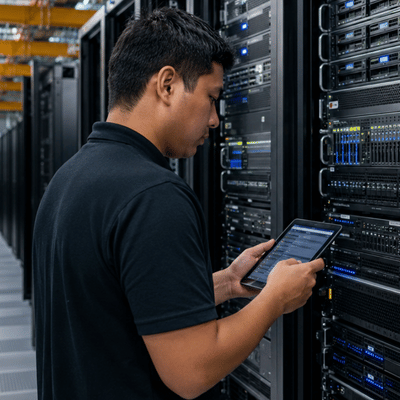
Buying a server is about much more than just CPU speed and price. Artificial intelligence, virtual machines, edge work and storage growth have changed the process.
IDC said server spending jumped in late 2025, fueled by demand for GPU servers. Uptime Institute says AI is pushing denser racks, higher power use, and tougher cooling needs.
Compare each server by:
- Workload fit
- Management tools
- Hardware and firmware security
- Air or liquid cooling
- Support and parts access
How the Top Server Companies Compare
| Brand | Best Fit | Key Strength |
|---|---|---|
| Dell PowerEdge | Mixed enterprise fleets | OpenManage and a broad range |
| Lenovo ThinkSystem | Business IT and AI inference | Strong rack and tower options |
| HPE ProLiant | Secure and distributed IT | Trust and cloud management |
| Acer Altos | Value SMBs and schools | Practical AI options |
| Gigabyte | AI, HPC, and GPU-heavy work | GPU density and cooling |
| Thinkmate | Custom GPU and HPC builds | Flexible builds and QuickShip |
Dell PowerEdge: Management and Security
Dell PowerEdge fits large, mixed environments. Dell offers systems for data centers, edge sites, AI, and rack builds.
The main difference is management depth. Dell OpenManage and iDRAC help teams monitor, update, and control servers at scale. Newer PowerEdge systems also focus on cyber-safe design and hardware-level trust.
Performance varies depending on workload, processor selection, storage configuration, and benchmarking methodology. Its strength is simple fleet control across many workloads and sites.
Lenovo Rack and Tower Servers
Lenovo rack servers compete closely with Dell and HPE. The ThinkSystem SR650 V4 supports Intel Xeon 6 processors, dense memory, and fast NVMe storage. Lenovo also offers XClarity management and Neptune cooling.
The published VMmark 4 score showed Lenovo’s SR650 V4 beating a comparable Dell R770 in that tested virtual environment. That doesn’t mean Lenovo always wins. “Demonstrates Lenovo rack servers can perform well if configured properly.
Lenovo tower servers are also powerful. The ThinkSystem ST650 V3 supports dual Intel Xeon Scalable processors, large capacity DDR5 memory, options for GPUs, and many drives. Fits offices, labs, and branch sites that require power but not a full rack.
HPE Compute: Secure and Cloud-Ready

HPE Compute focuses on secure operations and cloud-based management. HPE Compute Ops Management helps teams onboard systems, apply policies, track compliance, and manage servers across sites.
HPE also uses Silicon Root of Trust to help protect server firmware at the hardware level. This makes HPE a strong fit for health care, finance, and other sensitive settings.
HPE ProLiant DL560 Gen11 is a 2U chassis with four processors and supports up to 16TB of DDR5 memory. Another four-socket server is Dell’s PowerEdge R960, but it is a 4U chassis. If rack space is at a premium, then the HPE DL560 is better.
Acer, Gigabyte, and Thinkmate
Acer Altos
Acer Altos fits value-focused buyers, schools, and regional teams. Acer offers tower, rack, storage, and multi-node systems. Altos also announced an AI server that supports up to eight NVIDIA RTX PRO 6000 Blackwell or H200 NVL GPUs.
Gigabyte
Gigabyte is a good fit for AI, HPC, data science, and GPU-heavy work. It offers systems with accelerators from NVIDIA, AMD, and Intel, as well as air, direct liquid, and immersion cooling.
Thinkmate
For custom builds, Thinkmate is the best. Its RAX and GPX lines support a variety of CPU and GPU options, including AMD EPYC and Intel Xeon options. Good for HPC, AI, and buyers who want a custom setup fast.
Do you have any recommendations for good server brands or manufacturers?
Yes. For most companies, Dell, Lenovo, and HPE are the default mainstream options. Gigabyte is strong in AI and HPC. Thinkmate is for custom builds. Acer Altos is for value needs.
What are the main differences between Dell PowerEdge servers and other brands?
Dell PowerEdge stands out for broad product coverage and strong management tools. OpenManage and iDRAC help IT teams manage many systems from one place. Dell is a safe choice for mixed workloads and many locations.
How do Lenovo rack and tower servers compare to other brands?
Lenovo rack servers can compete closely with Dell and HPE. The SR650 V4 supports current Intel Xeon 6 options and fast NVMe storage. Lenovo tower servers, such as the ST650 V3, offer strong power for offices that do not need a rack.
How do Acer and Gigabyte servers compare to other brands?
Acer Altos can perform well when sized for the right job, including some AI workloads. Gigabyte is stronger for GPU-heavy AI and HPC systems. Dell, Lenovo, and HPE are easier defaults for broad business IT.
How does the HPE DL560 compare to other enterprise servers?
HPE DL560 Gen11 is a 2U chassis that can house four processors. Supports up to 16TB of DDR5 memory, depending on configuration. It’s a good option when the priority is on memory density and rack space.
How do Thinkmate servers stack up against other brands?
Thinkmate servers perform well when constructed for the workload. They are better suited for custom GPU, HPC and AI systems. Global fleet management might be easier with Dell, Lenovo and HPE.
No one brand wins every use case. Stick with Dell, Lenovo or HPE for regular business IT. Go Gigabyte for dense AI systems. Custom builds from Thinkmate. When value and local support count, go for Acer Altos.
Need help choosing the right fit? Get a Quote from Down to Earth Technology and build a server setup around your real workload.